1. Overview
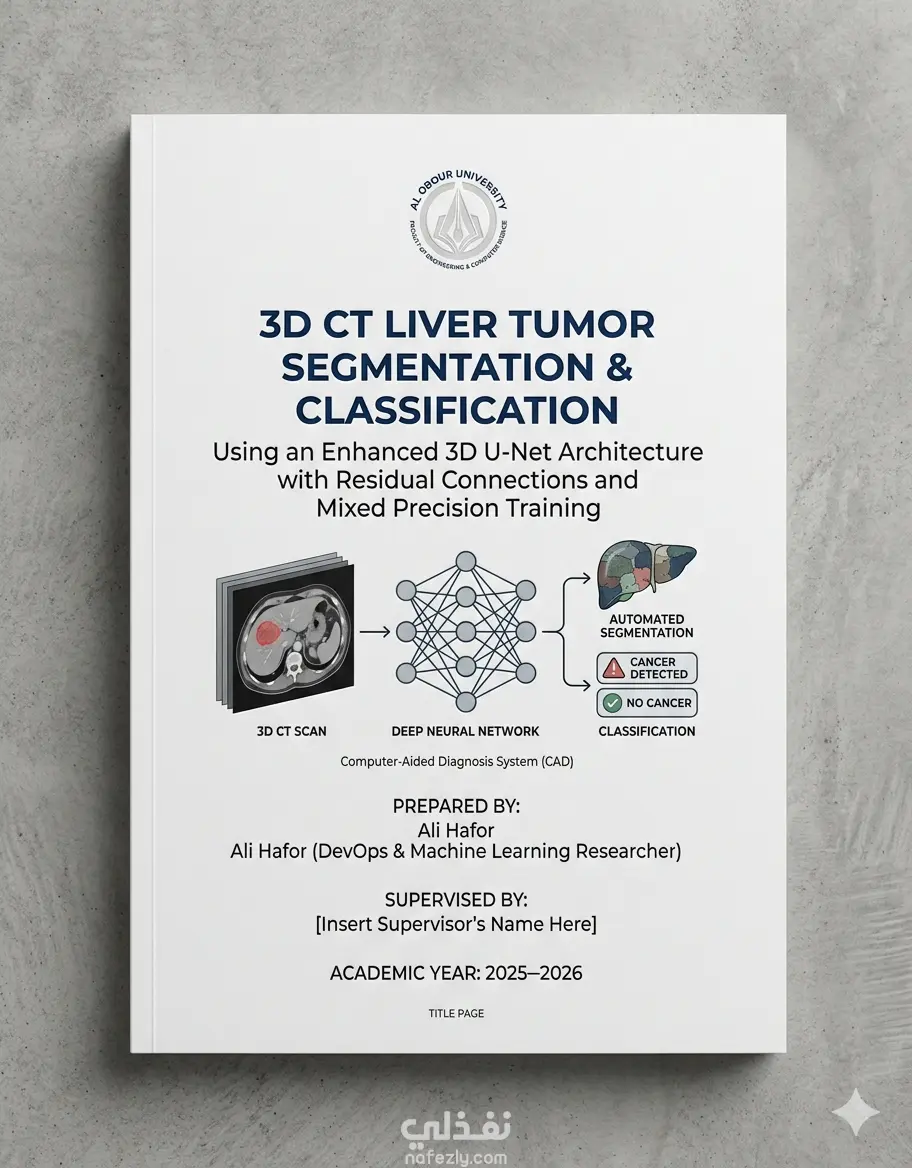
This project presents an end-to-end medical AI solution designed to automate the detection and segmentation of liver tumors from 3D Computed Tomography (CT) scans. By utilizing state-of-the-art Deep Learning techniques, the system assists radiologists in identifying cancerous tissues and calculating tumor-to-liver volume ratios with high precision.
2. Technical Methodology
The core of the system is an Improved 3D U-Net architecture, enhanced with several modern optimizations:
Residual Connections: Integrated to improve gradient flow and allow the model to learn more complex features during training.
Mixed Precision Training: Utilizes float16 for computations to significantly speed up training and reduce GPU memory consumption.
Advanced Preprocessing: Implements Hounsfield Unit (HU) windowing (clipping between -100 and 400 HU) to isolate soft tissue and normalize intensities for better model convergence.
Memory Efficiency: Features a custom data generator with caching and dynamic batch sizing to handle heavy 3D NIfTI files without overloading system memory.
3. Key Features
Dual-Purpose Output: The model performs Segmentation (pixel-wise tumor mapping) and Classification (diagnosing "Cancer Detected" vs. "No Cancer" based on tumor ratio).
Combined Loss Function: Uses a blend of Binary Crossentropy and Dice Loss to tackle the class imbalance problem inherent in medical imaging (where tumors are small compared to the whole scan).
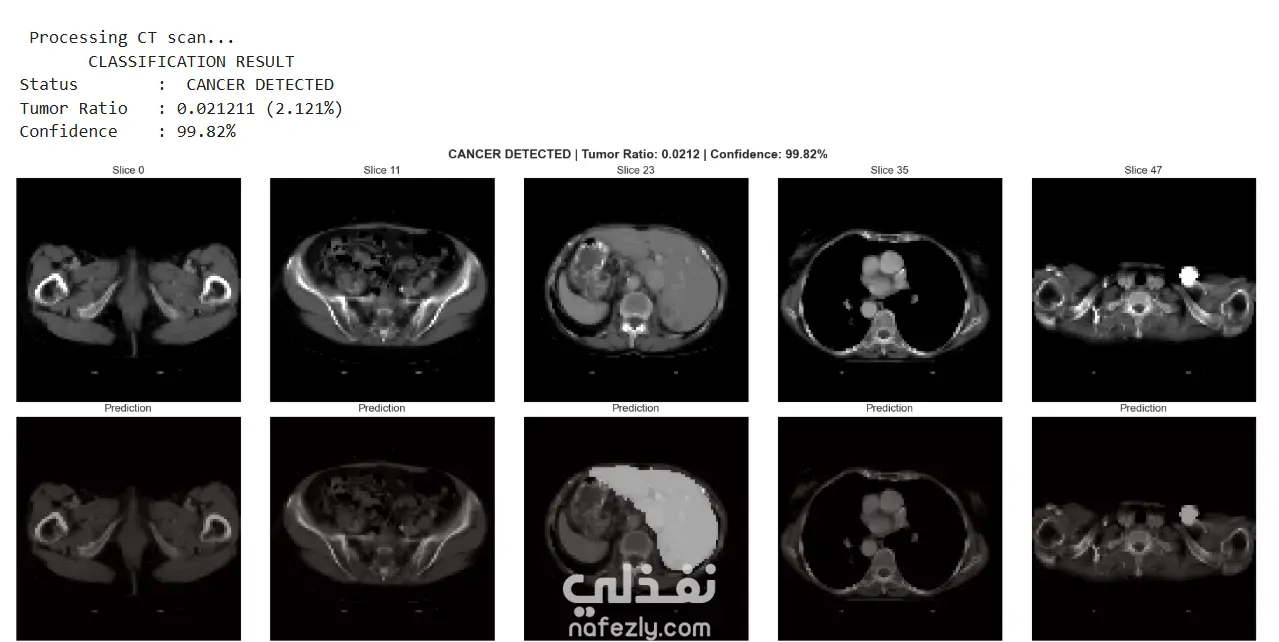
Comprehensive Visualization: Includes a full pipeline to visualize raw scans, resized masks, and final overlays across multiple 3D slices.
Reliability Metrics: Evaluates performance using the Dice Coefficient, a standard in medical imaging to measure the overlap between the ground truth and the model's prediction.
4. Practical Application
The final model is capable of processing new NIfTI files, providing a diagnostic status, a tumor-to-liver ratio, and a confidence score. This serves as a vital Computer-Aided Diagnosis (CAD) tool, reducing the manual workload for medical professionals and increasing the accuracy of early cancer detection.